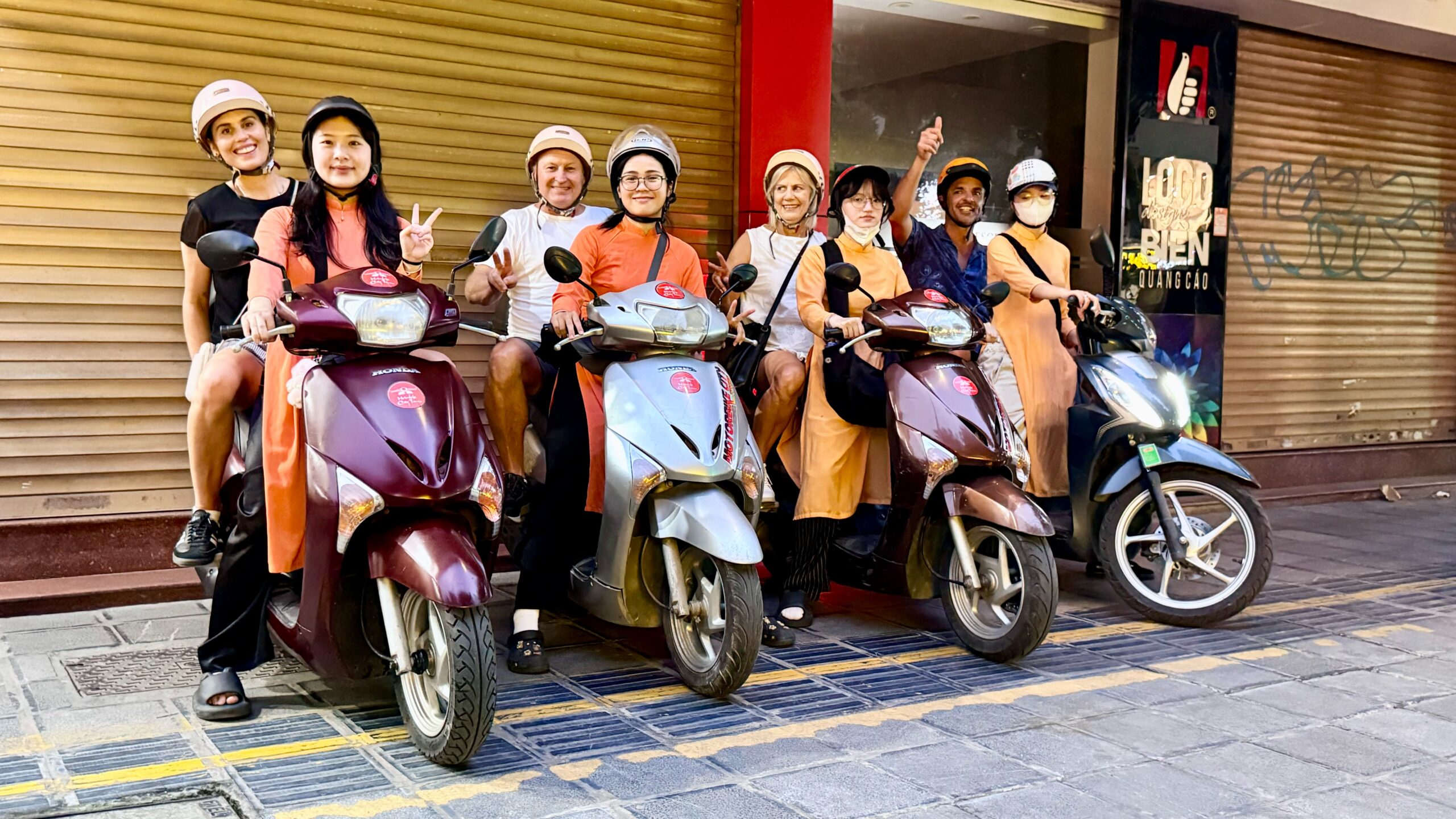
Hanoi Vespa Experience: Discover the Culture Behind the Streets
A Hanoi Vespa Experience: Discover the Culture Behind the Streets is a different way to understand Vietnam’s capital. Instead of moving from one famous monument to another, you travel through the streets where Hanoi’s history, food, family life, architecture, religion, commerce, and modern city culture meet.
From the back of a Vespa, the city feels much closer. You can move through the Old Quarter, pass narrow residential alleys, explore the French Colonial Quarter, ride toward Long Bien Bridge, see the Red River landscape, visit West Lake, and stop for Vietnamese food or coffee. The Vespa becomes a way to connect these different parts of Hanoi rather than simply a means of transportation.
Asia Motorbike Adventures focuses on women-led Vespa and motorbike experiences that combine Hanoi’s major landmarks with hidden streets, markets, historic neighborhoods, family-run food establishments, lakes, and quieter areas.
Culture Is Not Only Inside Museums
One of the easiest mistakes first-time visitors make in Hanoi is assuming that Vietnamese culture is found mainly inside temples, museums, and historic monuments.
Those places are important, but Hanoi’s culture is also visible on the pavement outside a small restaurant, in the way a family uses the ground floor of a narrow house, in a neighborhood market, at a roadside coffee stall, or in the way people gather around a bowl of noodles.
A Vespa allows you to see these details while moving naturally through the city.
You are not separated from Hanoi by a bus window.
You are close to it.
Start With the Old Quarter
The Old Quarter is one of the best places to begin understanding Hanoi’s urban culture.
Its narrow streets developed around traditional craft and trading communities, and many streets historically became associated with particular products or trades.
Today, the neighborhood is a mixture of old houses, restaurants, cafés, shops, hotels, street vendors, and modern businesses.
A Vespa can take you beyond the busiest tourist streets into smaller lanes where everyday life continues alongside tourism.
For curious travelers, this is where the tour becomes more than sightseeing.
Look at the Houses
Hanoi’s old houses tell a story.
Many buildings in the Old Quarter are narrow at the street front but extend surprisingly far behind the entrance.
This historic pattern developed partly because of taxation and the value of street frontage.
From the Vespa, you can observe how these older structures now coexist with cafés, family businesses, modern apartments, and shops.
Your guide can explain the architectural differences and how Hanoi’s traditional urban neighborhoods have changed.
Discover the French Colonial Quarter
A short ride can create a dramatic contrast.
The narrow streets of the Old Quarter give way to the wider roads and grander buildings of the French Colonial Quarter.
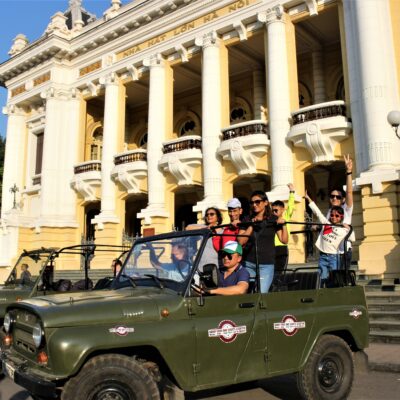
Here, Hanoi’s colonial history becomes visible through architecture, tree-lined boulevards, government buildings, villas, and the Hanoi Opera House.
This contrast is one of the most interesting cultural features of Hanoi.
You are not visiting two separate cities.
You are seeing different historical periods layered into the same city.
Ho Chi Minh’s Place in Modern Vietnam
A cultural Vespa itinerary can also pass through the Ba Dinh area, where several important national landmarks are located.
The Ho Chi Minh Mausoleum, Presidential Palace, and Ba Dinh Square provide an opportunity to understand an important part of modern Vietnamese history.
A guide can explain the historical significance of the area rather than simply pointing out the buildings.
For travelers interested in Vietnamese history, this context makes the sightseeing considerably more meaningful.
Temple of Literature and Vietnam’s Educational Tradition
The Temple of Literature provides another cultural perspective.
Founded in 1070 and associated with Confucian education, the site reflects the importance historically placed on scholarship, learning, teachers, and academic achievement.
For many Vietnamese families, education remains an important cultural value.
Visiting the Temple of Literature therefore gives travelers an opportunity to connect an ancient institution with values that continue to influence Vietnamese society today.
A Vespa tour can place this historical site within a much wider picture of Hanoi rather than treating it as an isolated attraction.
Hanoi’s Culture Is Also About Food
You cannot understand Hanoi without talking about food.
Food is deeply connected to neighborhood life.
People gather around small tables, restaurants specialize in particular dishes, and some businesses have been serving the same style of food for generations.
A Vespa experience can incorporate food stops, particularly on dedicated food itineraries.
Asia Motorbike Adventures’ food-focused Vespa experiences feature dishes such as Bánh Cuốn, Bún Chả, Phở, grilled seafood, banana flower salad, and Egg Coffee.
The important part is not simply tasting the dishes.
Ask your guide why they are popular, how they are prepared, and how Vietnamese people normally eat them.
That is where food becomes culture.
Bánh Cuốn and the Culture of Fresh Preparation
Bánh Cuốn is a good example.
The rice batter is steamed into delicate sheets and prepared fresh before being served.
Watching the preparation gives you an understanding of the care involved in Vietnamese cooking.
The dish is simple in appearance, but its texture and preparation require skill.
A small family-run restaurant can therefore tell you something about Hanoi that a large international restaurant cannot.
Bún Chả and Hanoi’s Culinary Identity
Bún Chả is another dish strongly associated with Hanoi.
Grilled pork, rice noodles, herbs, vegetables, and dipping sauce come together in a meal that is both simple and surprisingly complex.
The smoky smell of the meat cooking beside the street is part of the experience.
For a visitor, eating Bún Chả with a guide provides an opportunity to understand not only what the dish contains but also how it fits into Hanoi’s everyday food culture.
Egg Coffee and Café Culture
Hanoi’s café culture offers another cultural window.
Egg Coffee is perhaps the city’s most famous specialty drink.
Strong Vietnamese coffee is combined with a rich, creamy egg topping to create something that sits somewhere between a coffee and dessert.
Stopping at a café after riding through Hanoi gives you a chance to slow down and observe another part of city life.
Cafés are not simply tourist attractions.
They are places where people meet, work, talk, read, and relax.
Explore Hanoi’s Hidden Alleys
The most memorable cultural discoveries are often found away from major landmarks.
A Vespa is particularly useful because it can navigate many of Hanoi’s narrow lanes.
You may pass a small school, a neighborhood market, a family home, a repair shop, a café, or a tiny food business.
These scenes may appear ordinary, but they reveal how the city actually functions.
Asia Motorbike Adventures emphasizes hidden alleyways, markets, schools, local neighborhoods, and everyday street environments across its Hanoi riding experiences.
Markets Show Everyday Hanoi
Markets are another important part of the city’s culture.
Rather than simply shopping for souvenirs, observe how residents buy vegetables, meat, herbs, fruit, household items, and prepared food.
Notice how vendors arrange their products.
Listen to the sounds.
Look at the colors.
Watch how customers negotiate and choose ingredients.
For travelers interested in culture, these ordinary scenes can be more revealing than a formal attraction.
Hanoi Train Street and Urban Change
Hanoi Train Street offers an unusual example of how different parts of the city can exist side by side.
A functioning railway passes through a densely developed residential environment, creating a narrow corridor between houses and the tracks.
The area also demonstrates how Hanoi has changed as tourism has grown.
If Train Street is included in your route, your guide can explain its history and the current situation around visitor access.
Because it remains an active railway, visitors should stay within permitted areas and follow current safety instructions.
The goal is to understand the neighborhood—not to put yourself in danger for a photograph.
Long Bien Bridge: History Above the Red River
The ride toward Long Bien Bridge provides another cultural transition.
The historic bridge connects Hanoi’s urban center with areas around the Red River and remains an important visual symbol of the city.
From the bridge, the landscape changes dramatically.
You can see the river, railway, agricultural areas, banana plantations, and the city skyline.
A full-day Vespa experience can combine Long Bien with Red River agricultural villages and plantations, creating a direct contrast between urban and rural Hanoi.
See the Agricultural Side of Hanoi
Many international visitors are surprised to discover how quickly Hanoi’s landscape becomes green.
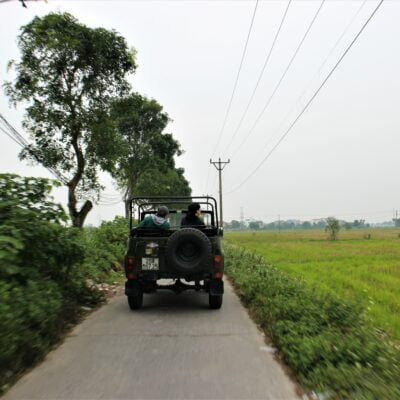
Around the Red River, agricultural areas include vegetable gardens, flowers, bananas, and other crops.
This is still Hanoi.
That is an important cultural lesson.
The capital is not only high-rise buildings, traffic, cafés, and historic monuments.
Agricultural communities continue to exist alongside one of Southeast Asia’s fastest-changing urban environments.
West Lake and a Slower Side of Hanoi
After the intensity of the Old Quarter, West Lake offers a different rhythm.
The lake is surrounded by residential neighborhoods, cafés, restaurants, temples, and tree-lined roads.
People come here to exercise, socialize, eat, drink coffee, and enjoy the water.
For travelers interested in contemporary Hanoi, West Lake provides a glimpse into how residents use public spaces and neighborhoods away from the historic center.
Truc Bach Lake
Nearby Truc Bach Lake adds another layer to the story.
The area combines water, residential streets, restaurants, temples, and historic sites.
Riding between West Lake and Truc Bach allows you to experience how Hanoi’s lakes shape the city’s geography and daily life.
They are not simply scenic attractions.
They influence where people live, eat, exercise, and spend their free time.
Meet Hanoi Through a Female Guide
A women-led Vespa experience adds another human element.
Your guide is not only responsible for navigating Hanoi.
She can talk with you about food, family traditions, neighborhoods, history, work, and everyday life.
For travelers interested in culture, this conversation can be more valuable than memorizing a list of dates.
You can ask questions that arise naturally during the ride.
Why do people sit on small plastic stools?
Why are so many businesses operated from family homes?
Why are there so many cafés?
How do Vietnamese families celebrate important occasions?
What foods are traditionally eaten for breakfast?
The answers help connect what you see on the street with Vietnamese society.
Culture Through Everyday Conversations
One advantage of a private Vespa experience is that conversations can develop naturally.
If you are interested in Vietnamese weddings, ask.
If you are curious about family life, ask.
If you want to understand Hanoi’s food culture, ask.
If you want to know why the streets are organized in a particular way, ask.
A good guide can turn observations into stories.
This is especially useful for travelers who prefer understanding a destination rather than simply photographing it.
Private Vespa Experiences Give You More Freedom
Private touring is particularly suitable for culturally curious travelers.
You can spend more time at a location that interests you and less time at one that does not.
If architecture is your passion, focus on historic buildings.
If food is your priority, spend more time tasting.
If photography is important, allow extra time for stops.
If you want to see both Hanoi’s urban and agricultural sides, choose a longer itinerary.
The private format gives the guide more room to adjust the experience around you.
Morning or Afternoon?
The time of day can influence the cultural experience.
Morning is excellent for seeing Hanoi at the beginning of its daily rhythm. Markets are active, restaurants are preparing breakfast, and the streets gradually become busier.
Afternoon provides warmer light and a more relaxed start for travelers who prefer sleeping later.
Sunset offers an especially attractive combination of lakes, bridges, architecture, and changing city light.
Evening is ideal if food and street life are your priorities.
The best choice depends on which side of Hanoi you most want to see.
What About Rain?
Rain does not necessarily stop a Vespa experience.
Asia Motorbike Adventures promotes its Vespa experiences as operating in changing weather conditions and provides rain protection where applicable.
Rain can actually reveal another side of Hanoi.
Umbrellas appear everywhere.
Food stalls become warmer and brighter.
Street lights reflect on wet pavement.
People gather inside cafés and restaurants.
For photographers, rainy Hanoi can be remarkably atmospheric.
Safety remains the priority, however, and routes can be adjusted when conditions require it.
You Don’t Need Motorcycle Experience
You do not need to know how to drive a Vespa.
You ride as a passenger behind a professional driver-guide.
This is one of the reasons the experience works well for travelers who are fascinated by Hanoi’s scooter culture but have no desire to navigate the traffic themselves.
You get the mobility and street-level perspective without the responsibility of driving.
What Should You Wear?
Comfortable clothing is best.
Choose secure shoes and avoid carrying a large backpack.
Sunglasses are useful during daytime rides, while a light jacket can help during cooler weather.
If you are visiting during the rainy season, rain protection is provided on applicable tours.
If photography is important, keep your equipment safely stored while the Vespa is moving and take photographs when the scooter has stopped.
How Long Should the Cultural Experience Be?
A half-day tour is enough for a strong introduction to Hanoi’s central culture.
You can combine the Old Quarter, French Quarter, major landmarks, hidden streets, railway areas, lakes, food, and coffee.
A full-day experience allows you to add the Red River and agricultural side of Hanoi.
Asia Motorbike Adventures currently offers a full-day city-and-countryside Vespa itinerary of approximately eight hours, from 8:00 AM to 4:00 PM, including major city sights, Long Bien Bridge, Banana Island, agricultural areas, and food.
What Makes This Different From a Normal City Tour?
A conventional city tour often answers the question:
“What is this building?”
A cultural Vespa experience can go further:
“Why is this building important?”
Then further again:
“How does its history affect Hanoi today?”
That difference matters.
Culture becomes more interesting when it is connected to everyday life.
A Typical Cultural Route
A well-balanced route might connect the Old Quarter, French Colonial Quarter, Ba Dinh area, Temple of Literature, Train Street, Long Bien Bridge, Red River agricultural areas, West Lake, and Truc Bach Lake.
Between these major areas, the Vespa travels through smaller streets and neighborhoods.
This creates a natural story:
old Hanoi → colonial Hanoi → modern Hanoi → working neighborhoods → railway Hanoi → riverside Hanoi → agricultural Hanoi → contemporary lakeside Hanoi.
That is far more representative of the city than visiting only three monuments.
Food, Architecture and People Belong Together
One of the most useful things to understand about Hanoi is that culture is interconnected.
Architecture influences how people use the street.
The street influences food businesses.
Food businesses influence neighborhood life.
The lakes influence recreation.
The Red River influences agriculture.
The railway influences urban development.
The Vespa allows you to move through these different environments quickly enough to understand their relationship.
Who Will Enjoy This Experience?
This type of tour is particularly suitable for:
First-time visitors who want more context than a standard sightseeing itinerary.
Repeat visitors who have already seen Hanoi’s major monuments and want to explore deeper.
Food lovers who want to connect Vietnamese cuisine with neighborhoods and everyday life.
Photographers who want a mixture of architecture, people, food, streets, and landscapes.
Couples who prefer a private and flexible experience.
Solo travelers who enjoy conversation and discovery.
Families who want a comfortable way to cover more ground without walking all day.
Final Thoughts
A Hanoi Vespa Experience: Discover the Culture Behind the Streets is ultimately about looking beyond the obvious.
The Old Quarter tells one story.
The French Quarter tells another.
The Temple of Literature reveals Vietnam’s long educational tradition.
Train Street shows an unusual relationship between railway infrastructure and urban life.
Long Bien Bridge connects the city with the Red River landscape.
West Lake reveals another side of contemporary Hanoi.
And the food stalls, cafés, markets, homes, and small businesses connect all of these places to everyday life.
The Vespa brings them together.
You are not simply checking attractions off a list. You are moving through Hanoi slowly enough to notice the details, while covering enough ground to understand how the different parts of the city connect.
For travelers who want to know why Hanoi looks, tastes, and feels the way it does, a women-led Vespa experience can be one of the most engaging ways to discover the city.
Book Your Hanoi Vespa Cultural Experience
Asia Motorbike Adventures – Hanoi
Website: asiamotorbikeadventures.com
WhatsApp / Call 24/7: +84 982 416 518 / +84 981 090 989
Email: info@asiamotorbikeadventures.com
Address: 91 Tho Nhuom Street, Hoan Kiem District, Hanoi
Private and small-group Vespa experiences are available, with professional women guides, quality scooters, helmets, rain protection, insurance, and applicable hotel pickup and drop-off.