Hanoi Motorbike Tour With a Local Guide: What to Expect
A Hanoi Motorbike Tour With a Local Guide is very different from simply taking a taxi between famous attractions. Instead of staying on the main roads, you ride as a passenger with a local driver-guide through narrow alleys, residential neighborhoods, markets, historic areas, lakes and quieter parts of Hanoi that are difficult to reach by car.
For international travelers, this is one of the easiest ways to combine Hanoi sightseeing, local culture, street food and everyday life in a single experience. Current Hanoi motorbike tours offered by Motorbike City Tours typically run for around 4–4.5 hours, with morning and afternoon departures, and include a local guide, motorbike, driver, food and drinks depending on the selected itinerary.
What Does a Local Guide Actually Do?
Your local guide is much more than someone who shows you where to go.
During the ride, the guide explains the history behind landmarks, introduces Vietnamese customs, points out interesting details in neighborhoods and helps you understand what you are seeing from the back of the motorbike.
A typical guided route can combine the Old Quarter, French Quarter, Long Bien Bridge, local markets, Banana Island, West Lake, Huu Tiep Lake and Train Street. The exact route varies by tour and conditions.
The biggest advantage is context. You are not simply passing a market—you can learn what local people buy there. You are not simply crossing Long Bien Bridge—you can hear why it is important to Hanoi. You are not simply seeing a residential alley—you can ask how people live there.
1. Your Guide Usually Meets You at Your Hotel
The experience normally starts at your hotel or an agreed meeting point.
Current Motorbike City Tours information states that guides and drivers meet guests at hotels in and around Hanoi’s Old Quarter, with a convenient meeting point available when necessary.
You don’t need to spend time finding a motorcycle rental shop or figuring out how to reach the starting point yourself.
Your guide will introduce the itinerary, make sure you are comfortable and explain the basic safety procedures before the ride begins.
2. You Ride as a Passenger
One of the most common questions from international travelers is:
“Do I have to drive the motorbike?”
No.
For these guided experiences, guests ride as passengers behind experienced, licensed driver-guides.
This is particularly useful in Hanoi because traffic can initially look overwhelming to visitors.
You can concentrate on the scenery, take photographs when stopped and listen to your guide rather than worrying about navigation.
3. Expect a Safety Briefing Before Departure
Before riding into Hanoi’s traffic, your guide should explain how to sit comfortably, how to get on and off the scooter and what to do during the ride.
Current Motorbike City Tours information states that the tour begins with a safety briefing and uses Honda Lead scooters equipped with passenger backrests.
Helmets and rain protection are also included on the published tour information.
This short introduction is especially useful if you have never ridden as a passenger on a motorbike in Vietnam before.
4. The First Part Usually Explores Central Hanoi
Once everyone is ready, the tour moves into Hanoi’s streets.
You may begin around the Old Quarter and French Quarter, passing historic buildings, local businesses, cafés and narrow residential lanes.
The advantage of a motorbike becomes obvious here.
A scooter can move through streets and alleys that are difficult for larger vehicles to navigate. Current tour itineraries specifically emphasize hidden backstreets and areas that cars and buses cannot easily reach.
Instead of seeing Hanoi only from major roads, you begin to see the city at street level.
5. Your Guide Explains the History Along the Way
A good local guide turns the journey into a moving history lesson.
Depending on the route, your guide may explain:
- Hanoi’s French colonial period
- The history of Long Bien Bridge
- The Vietnam War
- The development of Hanoi’s Old Quarter
- Traditional Vietnamese architecture
- Local religious practices
- Hanoi’s changing neighborhoods
- Modern Vietnamese life
For example, current Motorbike City Tours itineraries include Huu Tiep Lake and the remains of a B-52 bomber, providing an opportunity to discuss Hanoi’s wartime history in the context of a neighborhood where everyday life continues around the historical site.
6. You Will See More Than Famous Attractions
A local-guide motorbike tour isn’t designed simply to check famous landmarks off a list.
You may see:
Local markets → residential alleys → small cafés → family businesses → temples → street vendors → agricultural land → lakeside neighborhoods.
This is what makes the experience different from a conventional city sightseeing tour.
The current City Insight route, for example, combines major sights with markets, hidden alleys, Banana Island and local communities.
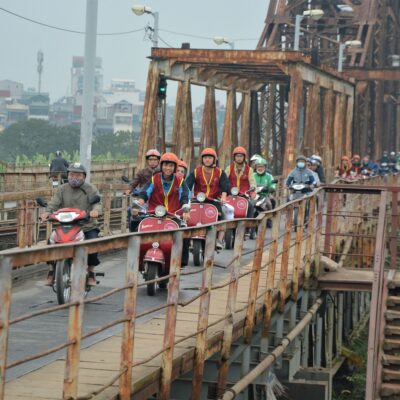
7. Long Bien Bridge Is Often a Highlight
Long Bien Bridge is one of the most recognizable structures in Hanoi.
Crossing the bridge by motorbike gives you an entirely different perspective from viewing it from a car.
From the bridge, you can see the Red River, surrounding neighborhoods and the changing landscape of Hanoi.
Your guide can also explain the bridge’s history and importance to the city’s development.
Current Motorbike City Tours routes include Long Bien Bridge as a major part of their Hanoi motorbike experiences.
8. You May Suddenly Leave the City Behind
One of the most surprising moments on a Hanoi motorbike tour is the transition from urban streets to countryside.
After crossing Long Bien Bridge, some routes continue toward Banana Island, an agricultural area within Hanoi.
Instead of skyscrapers and busy roads, you can find banana trees, vegetable gardens, dirt paths and farmers working the land.
Current City Insight itineraries specifically describe riding through the agricultural countryside of Banana Island.
This contrast is one of the best ways to understand Hanoi.
The city isn’t simply an urban environment. Agriculture, villages and modern neighborhoods exist remarkably close together.
9. Your Guide Can Explain Everyday Vietnamese Life
This is where having a local guide becomes especially valuable.
You can ask questions that you wouldn’t necessarily find in a guidebook:
Why do people eat breakfast so early?
Why are there so many cafés?
What are those tiny houses?
Why do people sit on small plastic stools?
What are the vegetables being sold at the market?
Why do so many families operate businesses from their homes?
What is Vietnamese family life like?
The answers help transform the tour from sightseeing into cultural understanding.
10. Expect to Ride Through Narrow Alleys
Don’t expect the entire tour to take place on wide city streets.
One of the main attractions of a motorbike experience is entering smaller roads and alleys.
You may pass:
- Small homes
- Local restaurants
- Repair shops
- Street vendors
- Cafés
- Temples
- Markets
- Neighborhood schools
- Small family businesses
Current tour descriptions emphasize navigating Hanoi’s winding backstreets and labyrinth-like alleys.
These areas often provide a much more interesting view of Hanoi than another major tourist attraction.
11. West Lake Can Be a Relaxing Break
After the intensity of central Hanoi, riding along West Lake can feel completely different.
The roads around the lake provide open views and a breeze, while cafés, restaurants and residential neighborhoods line the surrounding streets.
Depending on the itinerary, you may also see Truc Bach Lake and Tran Quoc Pagoda.
Current motorbike routes include West Lake and nearby areas as part of their city experiences.
12. You Can Ask Your Guide Questions Throughout the Tour
One major advantage of having a local guide is that the experience is interactive.
Don’t be afraid to ask questions.
You can ask about:
- Vietnamese food
- Local customs
- History
- Family life
- Hanoi neighborhoods
- Coffee culture
- Vietnamese weddings
- Motorbikes
- Housing
- Education
- Markets
- Local traditions
The best tours don’t feel like a guide giving a speech.
They feel like having a knowledgeable local friend showing you around their city.
13. Food Is Often Part of the Experience
Depending on the tour you choose, food may be an important part of the itinerary.
A daytime City Insight tour currently includes a local lunch and drinks, while food-focused motorbike experiences feature multiple Vietnamese dishes and beverages.
Typical dishes can include:
- Phở
- Bún Chả
- Bánh Cuốn
- Phở Cuốn
- Local grilled dishes
- Vietnamese desserts
- Egg Coffee
The food isn’t simply a restaurant stop.
Your guide can explain what you are eating, how it is traditionally prepared and how locals normally enjoy it.
14. Vietnamese Egg Coffee Is a Popular Finale
Many Hanoi motorbike itineraries finish with a local café experience.
One of the most famous choices is Vietnamese Egg Coffee.
It is made with strong Vietnamese coffee and a rich, creamy egg-based topping.
Current Motorbike City Tours itineraries include Egg Coffee as a final stop on several city motorbike experiences.
For many international visitors, this becomes one of the most memorable parts of the day.
15. The Tour Isn’t Only About Riding
This is important to understand before booking.
You are not paying simply to sit on a scooter for four hours.
A guided motorbike tour combines:
Transportation + sightseeing + local interpretation + food + culture + conversation + neighborhood exploration.
The motorcycle simply makes it possible to connect all these experiences efficiently.
16. Expect a Different Pace From a Walking Tour
A walking tour allows you to stop almost anywhere.
A motorbike tour is more fluid.
You ride for a while, stop to explore or take photographs, continue riding and then stop again for food or sightseeing.
This allows you to cover significantly more of Hanoi during a half-day experience.
Current city motorbike tours generally run for around 4–4.5 hours, depending on the itinerary.
17. What Should You Wear?
Keep your clothing simple and comfortable.
A good choice is:
- Lightweight trousers or comfortable shorts
- T-shirt or breathable shirt
- Comfortable shoes
- Sunglasses
- Sunscreen
- Light jacket or long sleeves when appropriate
Current tour guidance recommends light, comfortable clothing and shoes, sunscreen and sunglasses, with a light jacket or long-sleeved top recommended.
Avoid loose accessories that could become uncomfortable while riding.
18. What Happens If It Rains?
Normal rain does not necessarily mean cancellation.
Motorbike City Tours states that its tours operate rain or shine and provide rain ponchos when needed.
Your guide may also adjust the route depending on road conditions.
For heavy storms, flooding or unsafe visibility, however, safety should take priority over following the original itinerary.
19. Is a Motorbike Tour Safe for International Travelers?
A guided passenger tour is very different from renting a scooter yourself.
You are not responsible for navigating Hanoi traffic.
The operator provides the motorcycle and driver, while you ride as a passenger.
Current Motorbike City Tours information states that its drivers are experienced and licensed and that its scooters are regularly inspected and maintained. The company also lists passenger backrests and full-face helmets among its equipment.
As with any motorcycle experience, passengers should follow the driver’s instructions and wear the provided helmet properly.
20. Do You Need Previous Motorbike Experience?
No.
You don’t need to know how to operate a scooter because you’re riding as a passenger.
You simply need to feel comfortable sitting on a motorcycle and getting on and off several times during the tour.
If you’re nervous about your first ride in Hanoi, tell your guide before departure.
21. Will the Guide Speak English?
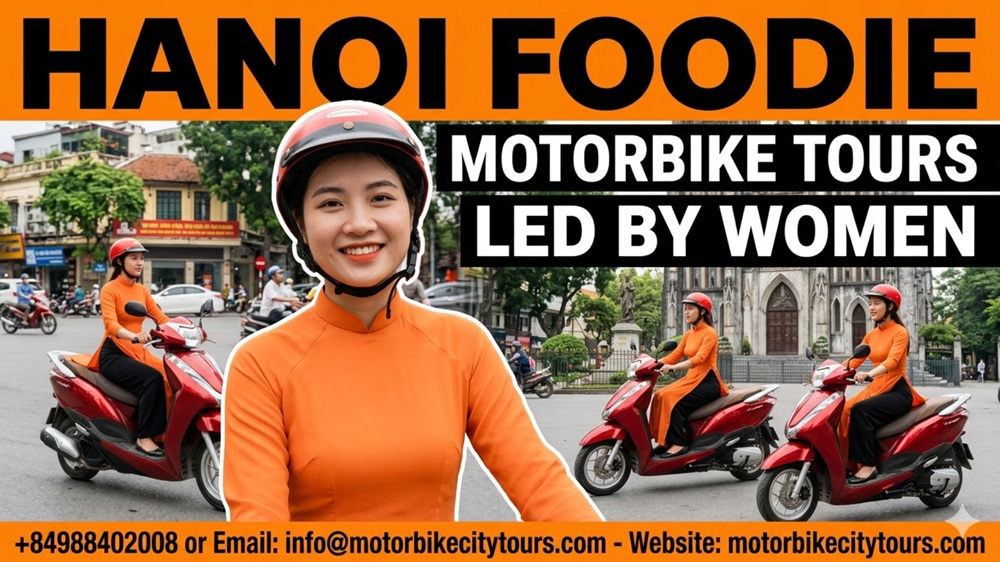
For the current Motorbike City Tours experiences, English-speaking guides are part of the service. The company describes its guides as professional English-speaking local guides and its female riders as experienced and licensed.
This is particularly important for a cultural tour.
A guide who can communicate naturally allows you to ask questions instead of simply listening to memorized descriptions.
22. What Makes a Local Guide Different From a Standard Guide?
A local guide can give you information based on personal experience and local knowledge.
For example, instead of saying:
“This is a traditional market.”
They can explain what locals buy there, when the market is busiest, which foods are seasonal and how the neighborhood has changed.
Instead of simply pointing toward a house, they may explain how Vietnamese homes are structured and why many narrow houses are built vertically.
That personal context is often what international travelers remember most.
23. Can You Meet Local People?
Some itineraries include opportunities to interact with residents.
Current Motorbike City Tours descriptions mention meeting local people, visiting homes and talking with residents over tea.
These moments can be more meaningful than simply photographing a landmark.
You get a chance to ask questions and see how ordinary people live.
24. What About Private Tours?
Many motorbike tours operate as small-group experiences, but private options can also be arranged.
Current Motorbike City Tours information states that its standard City Insight experience is a join-in group tour while private tours are available with an additional charge depending on group size.
A private tour is particularly useful if you want:
- A slower pace
- More photography stops
- Specific food preferences
- More guide interaction
- A customized route
- A family-only experience
- A couple-only experience
25. Morning or Afternoon?
For sightseeing and everyday life, both are useful.
Morning: 8:00 AM–12:30 PM
Morning is excellent for:
- Markets
- Local life
- Cooler temperatures
- Photography
- Countryside
- Lunch
Afternoon: 1:00 PM–5:30 PM
Afternoon is good for:
- Historical areas
- West Lake
- Local neighborhoods
- Train Street
- Sunset atmosphere
- Lunch at the beginning
Current Motorbike City Tours schedules list morning and afternoon departures within these approximate time ranges.
26. What Is the Best Part of Having a Local Guide?
The best part is arguably knowing what you would otherwise miss.
Hanoi is full of details that aren’t obvious to first-time visitors.
A local guide can point out a tiny temple hidden behind a row of shops, explain an unusual food, tell you why a street has its name or show you a neighborhood that you would probably never find alone.
The motorbike gives you access.
The guide gives that access meaning.
27. What Should You Expect From the Overall Experience?
A typical half-day can look something like this:
8:00 AM – Hotel pickup and safety briefing
8:15 AM – Ride through the Old Quarter and hidden alleys
9:00 AM – Historic landmarks and local markets
9:45 AM – Long Bien Bridge and Red River
10:15 AM – Banana Island and agricultural countryside
11:00 AM – West Lake and local neighborhoods
11:30 AM – Huu Tiep Lake / B-52 area or another local attraction
12:00 PM – Local lunch
12:30 PM – Vietnamese Egg Coffee
12:45 PM – Return to hotel
The exact route and timing can change according to traffic, weather and the selected tour, but this gives international travelers a realistic idea of the experience.
28. What Should You Not Expect?
A guided Hanoi motorbike tour is not a luxury chauffeur experience where you remain inside an enclosed vehicle.
You will experience:
- Traffic noise
- City smells
- Heat
- Humidity
- Road vibrations
- Busy intersections
- Narrow streets
That is precisely what makes it different.
If you want a completely quiet, air-conditioned sightseeing experience, a private car is more appropriate.
If you want to feel Hanoi rather than simply look at it through a window, the motorbike is much more immersive.
29. Who Is This Tour Best For?
A Hanoi motorbike tour with a local guide is particularly suitable for:
- First-time international visitors
- Couples
- Solo travelers
- Families
- Food lovers
- Photographers
- Travelers interested in local culture
- Repeat visitors wanting to go beyond the Old Quarter
- Travelers with limited time in Hanoi
It is especially useful if you want to experience many different sides of Hanoi in half a day.
30. What Makes It Different From a Normal City Tour?
A conventional city tour often follows a sequence of major attractions:
Attraction → bus → attraction → bus → attraction.
A motorbike tour is more fluid:
Neighborhood → alley → market → landmark → bridge → countryside → lake → local restaurant → café.
That difference is significant.
You aren’t simply visiting Hanoi’s attractions.
You are moving through Hanoi’s daily life.
Final Verdict: What Should You Expect?
When you book a Hanoi Motorbike Tour With a Local Guide, expect much more than a motorcycle ride.
Expect to meet a local guide, receive a safety briefing, ride as a passenger, explore narrow streets, cross Long Bien Bridge, discover local markets, see neighborhoods beyond the main tourist routes, potentially visit Banana Island and West Lake, learn about Hanoi’s history, taste Vietnamese food and finish with a local coffee experience. Current published itineraries from Motorbike City Tours reflect this combination of sightseeing, culture, food and local-life experiences.
The biggest benefit isn’t simply where the motorcycle takes you.
It’s what your local guide helps you understand along the way.
Book a Hanoi Motorbike Tour With a Local Guide
Motorbike City Tours offers Hanoi motorbike experiences with English-speaking local guides, professional licensed drivers, hotel pickup, helmets, rain protection and local food and drinks depending on the selected tour.
Our bookings fill up fast – book your tour today to secure your spots!
📞 Call / WhatsApp — BEST WAY TO CONTACT — 24/7: +84 988 402 008
📧 Email: info@motorbikecitytours.com
🌐 motorbikecitytours.com – Official Website
If you want to see Hanoi through the eyes of someone who actually knows the city, riding with a local guide is one of the most rewarding ways to explore it.